Here are three Costa Rica stories from the past few days for anglers and visitors. Environmental authorities say an olive ridley arribada at Ostional went on for more than 50 days and brought about 347,000 nesting females ashore, a total they say has no match in the historical record. The national 911 system now gets the location of callers on compatible Android phones automatically, which helps in a country where many places have no formal street address. And a new peer-reviewed study estimates that Costa Rica's highland forests hold close to six in ten of the world's remaining resplendent quetzals.
Ostional records an arribada of about 347,000 turtles
The Tico Times reported on November 27 that the Ostional National Wildlife Refuge in Guanacaste has recorded a mass nesting of about 347,000 female olive ridley sea turtles. The event began in September 2026 and lasted more than 50 days. The Ministry of Environment and Energy (MINAE) says it knows of no documented nesting event like it, at Ostional or anywhere else. Rangers from SINAC's Tempisque Conservation Area and researchers from the FUNDECODES foundation tracked the nesting around the clock.
MINAE's past figures show how unusual the total is. Peak months recorded:
- About 307,000 females in September 2021
- About 206,000 in November 2022
- About 111,000, 160,000 and 190,000 in the busiest months of 2023, 2024 and 2025
Ostional has had 11 arribadas so far in 2026. Scientists have not worked out why this one was so long and so large. One idea from environmental authorities is that turtles from different parts of North and South America reached Ostional at the same time. MINAE says more research is needed to test that. Refuge administrator Carlos Pizarro said steady monitoring is key to understanding the event and comparing it with past records.
If you plan to watch an arribada, the outlet notes the rules. You must enter the beach with an authorized local guide. You may not touch turtles or disturb nests, and flash photography is banned during night nesting.
911 now locates Android callers automatically
According to The Tico Times, Costa Rica's 911 system now gets the location of callers using compatible Android phones automatically. The system first announced the service on November 16, and the government highlighted it at its weekly press conference on Wednesday, November 25. It works on Android smartphones with built-in Google services. Location data is sent when the call is placed. This is separate from the 911 mobile app, which lets users share their location and chat with operators.
The outlet says the feature matters because many places in Costa Rica have no conventional street address and people often give directions by landmarks. That can be a real problem for visitors in remote or unfamiliar areas. Several groups built the service together:
- The mobile operators Kölbi, Claro and Liberty
- Google and Apple
- The science and telecom ministry MICITT, the regulator SUTEL and the data protection agency Prodhab
Apple took part, but the feature does not yet work on iPhones. Officials expect to add iOS later and have not given a date. 911 director Kathya Villar Bonilla said the tool supports emergency response but does not replace talking with operators. Callers should still answer questions, give any landmarks they can and follow instructions. Accuracy depends on mobile coverage, the device, the operating system and conditions on the ground. The system says location is shared only during an active emergency call and is not kept afterward. The outlet also notes that English-speaking help is not always available right away, so a few basic Spanish phrases can be useful.
Study: Costa Rica holds 58% of the world's quetzals
The Tico Times reported on November 26 on a study in the journal Bird Conservation International. It puts the world's resplendent quetzal population at about 334,000 birds, less than half of the previous published estimate of about 770,000 from 2023. Of these, about 193,900 live in Costa Rica and about 83,700 in Panama, so the two countries hold roughly 83% of the total. The remaining 56,500 or so are spread from southern Mexico to Nicaragua.
The authors, led by independent scholar Edward H. Backus, used satellite forest data from 1990, 2011 and 2021. They mapped cloud forest between 1,500 and 3,000 meters, the elevation band where quetzals breed. Across Mesoamerica, close to 30% of the 1990 breeding forest was gone by 2021. Losses were uneven:
- El Salvador lost 73% of its breeding habitat, Mexico 65% and Guatemala 53%
- Costa Rica lost 8%, about 32,800 hectares, and Panama 5%
Much of the difference comes down to the Cordillera de Talamanca. This range, which includes La Amistad International Park, holds a single block of breeding forest of about 442,000 hectares. In Costa Rica, about 371,000 of the 388,000 hectares of core habitat mapped were inside protected areas in 2021. The authors recommend that the IUCN move the species from Near Threatened to Vulnerable. They name conversion of forest to farms and pasture as the main threat, along with climate pressures on cloud forest. They also caution that the population figure is uncertain because field counts are limited. For visitors adding a highland birding day to a coastal trip, the study confirms that Costa Rica's protected Talamanca forests are the species' main stronghold.
For the latest on the water near Los Sueños, see our fishing reports or contact us to plan your trip.
Sources
- Costa Rica Records Historic Arribada of 347,000 Sea Turtles in Ostional — The Tico Times, November 27, 2026
- Costa Rica's 911 Can Now Locate Android Callers Automatically — The Tico Times, November 27, 2026
- Costa Rica Holds 58% of the World's Quetzals as Northern Forests Vanish — The Tico Times, November 26, 2026
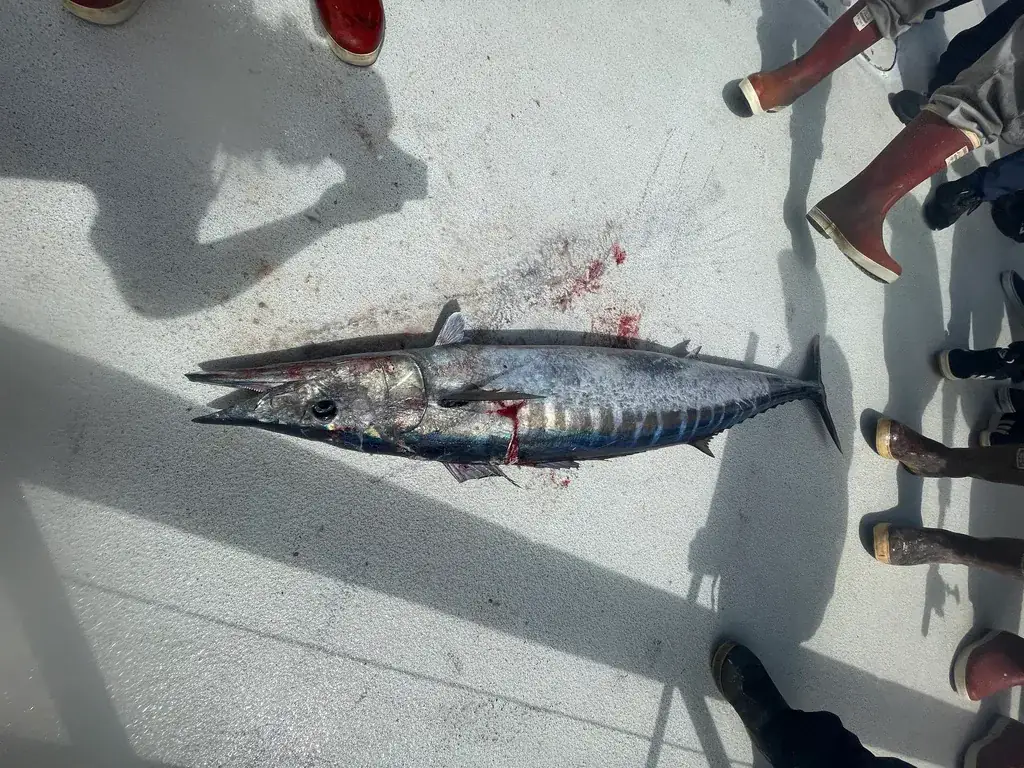
Photo from our gallery (wahoo); illustrative, not a photo of this story.